

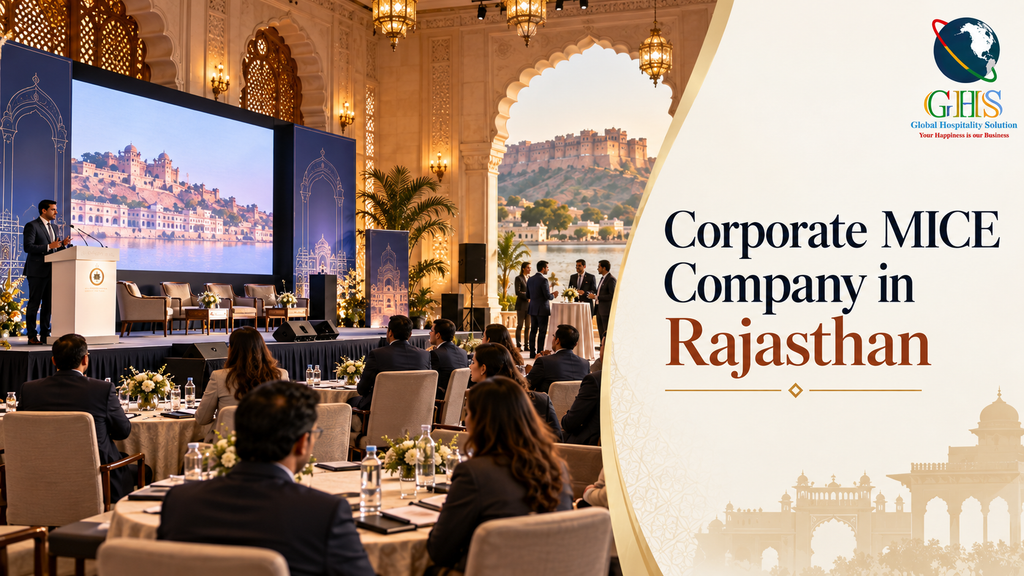
Rajasthan has become an important destination for companies planning meetings, incentive programmes, conferences and corporate events. The state’s combination of heritage venues, established hotels, air and rail connectivity, cultural experiences and destination-specific hospitality creates opportunities for both business-focused gatherings and programmes that combine professional objectives with curated experiences.
For a corporate organisation, however, MICE planning is considerably more complex than arranging a meeting room or booking a group of hotel rooms. A successful programme requires coordination between venue selection, accommodation, transportation, conference production, food and beverage, delegate management, activities and event schedules.
The role of a corporate MICE company in Rajasthan is to bring these different components together within a structured programme. The planning process begins with understanding the purpose of the event, the profile of participants and the expected business outcome, followed by selecting a destination and building the operational framework around those requirements.
Rajasthan offers several destination possibilities, but Jaipur, Udaipur and Jodhpur are particularly relevant for corporate programmes because of their connectivity, hospitality infrastructure and established tourism ecosystems. Rajasthan Tourism identifies Jaipur, Jodhpur and Udaipur among the state’s major air gateways, while road and rail networks connect these destinations with other parts of India. (Rajasthan Tourism)
Understanding MICE in a Corporate Context
MICE represents four related categories: Meetings, Incentives, Conferences and Events. Although these programmes are often grouped together, their objectives and operational requirements can differ considerably.
A meeting may involve a management team, sales force or regional business unit and require a relatively controlled environment. An incentive programme is more experience-oriented and is generally designed around employee or partner recognition. Conferences require greater emphasis on presentation infrastructure, delegate registration, seating, technical production and session management. Corporate events can combine several of these elements with launches, networking, awards or entertainment.
This distinction matters when planning a Rajasthan programme. A destination and venue that works effectively for a two-day management meeting may not have the infrastructure required for a 500-person conference. Likewise, a conference venue may not provide the atmosphere required for a small executive incentive programme.
MICE planning therefore starts with the event objective rather than the destination.
Why Rajasthan Is Relevant for Corporate MICE
Rajasthan offers a combination of business infrastructure and destination character that is useful for companies looking beyond conventional conference locations.
Jaipur provides strong accessibility and a broad hospitality ecosystem. Rajasthan Tourism notes that Jaipur is connected by air, rail and road with major Indian cities and also has international air connectivity.
This makes Jaipur particularly relevant for conferences, business meetings, annual gatherings and larger MICE programmes involving participants from multiple regions.
Udaipur offers a different proposition. Its lakes, palaces, resorts and surrounding landscape make the city suitable for executive retreats, incentive travel, leadership programmes and destination meetings. Rajasthan Tourism highlights its air, rail and road connections with cities including Ahmedabad, Delhi and Mumbai. (Rajasthan Tourism)
Jodhpur provides another distinctive setting, combining established tourism infrastructure with the heritage environment of the Marwar region. Its connectivity with Delhi and Mumbai by air, along with rail and road links, supports its use for destination programmes. (Rajasthan Tourism)
The choice between these destinations should therefore be determined by event format, participant profile, programme duration and operational requirements rather than destination popularity alone.
Planning the Four Components of MICE
Meetings: Creating an Environment for Productive Discussions
Corporate meetings often require privacy, efficient scheduling and reliable technical infrastructure rather than large-scale production.
For leadership meetings, board-level discussions and strategic workshops, room configuration can have a direct effect on the quality of interaction. Boardroom, U-shape, classroom and theatre layouts serve different purposes, while natural lighting, acoustics, room temperature, connectivity and access to refreshments can influence the practical usability of the space.
Accommodation should also be considered when meetings involve participants travelling from different cities. A venue that combines meeting facilities with appropriate hotel accommodation can reduce unnecessary transportation and simplify the daily schedule.
Incentives: Designing Experiences Around Recognition
Incentive travel has a different purpose from a standard corporate conference. The programme needs to create a sense of recognition while remaining professionally organised.
Rajasthan provides a strong foundation for incentive programmes because cultural experiences can be incorporated alongside accommodation and corporate activities. Depending on the destination and group profile, programmes can include heritage visits, curated dining, local cultural experiences, private activities and team-based experiences.
The important distinction is that these activities should be integrated into a structured corporate itinerary. An incentive programme should not simply become a collection of sightseeing activities. Timing, group movement, meal schedules, accessibility and participant preferences all require planning.
For international participants, cultural orientation and clear logistics become particularly important because unfamiliar travel environments can create operational challenges if the itinerary is not carefully coordinated.
Conferences: Balancing Content, Capacity and Production
Conferences place greater demands on venue and technical infrastructure.
A conference venue needs to accommodate not only the main audience but also registration, speaker preparation, breakout sessions, catering and technical operations. Depending on the format, organisers may also require exhibition areas, sponsor spaces, networking zones and dedicated rooms for speakers or organisers.
Audio-visual production is another central requirement. Presentation screens, LED walls, microphones, lighting, stage design, confidence monitors, recording and hybrid-event technology may all be required depending on the programme.
GHS provides production and A/V solutions that can be integrated into the wider event planning process, particularly where technical production is a significant part of the programme.
Events: Combining Business Objectives With Experience
Corporate events can include annual gatherings, award ceremonies, product launches, partner events and employee programmes. These formats often require a combination of formal content and experiential elements.
A product launch, for example, may require stage production, brand presentation, guest registration, product display areas, media coordination and hospitality. An annual corporate gathering may require awards, entertainment, dining and employee engagement.
The destination should support the desired event atmosphere without compromising logistical practicality.
Selecting the Right Rajasthan Destination
Jaipur for Business-Focused MICE Programmes
Jaipur is a practical option for organisations that prioritise accessibility, conference infrastructure and a broad range of accommodation.
Its airport and railway connectivity make it suitable for participants travelling from multiple Indian cities. The city also offers a mix of convention facilities, business hotels, heritage properties and venues suitable for different group sizes.
For larger conferences, the availability of multiple accommodation categories can also help planners accommodate executives, speakers, delegates and support teams within the same destination.
Udaipur for Incentives and Executive Programmes
Udaipur’s strongest MICE characteristic is its destination environment.
The city can work particularly well for executive retreats, incentive programmes, leadership gatherings and smaller conferences where the location itself contributes to the experience.
However, destination appeal should not replace operational assessment. Accommodation capacity, meeting-room requirements, airport transfers, vehicle movement and the timing of off-site activities need to be evaluated before finalising the programme.
Jodhpur for Heritage-Oriented Corporate Programmes
Jodhpur can suit businesses looking for a distinctive heritage setting for corporate gatherings and incentive programmes.
The city’s forts, historic architecture and regional character can be incorporated into carefully designed corporate experiences. At the same time, planners need to consider the distance between accommodation, venues and activities when developing the itinerary.
Venue Selection Is More Than Capacity
One of the most important MICE planning decisions is venue selection.
A venue should be evaluated according to the complete event programme rather than its main hall alone. Capacity, room configuration, breakout facilities, accommodation, food service, parking, loading access, technical infrastructure and delegate movement all influence operational suitability.
For example, a conference requiring six breakout sessions may need several smaller rooms even if the main auditorium has sufficient seating capacity. Similarly, an incentive programme may require outdoor areas, private dining spaces and flexible event zones.
GHS’s venue selection and banquet package services can support businesses evaluating venue and hospitality requirements as part of a broader MICE programme.
Accommodation and Hospitality Planning
Accommodation is often one of the largest components of a multi-day MICE programme.
Room blocks need to correspond with arrival schedules, participant categories and programme requirements. VIPs, speakers and senior executives may have different accommodation requirements from the wider delegate group.
Meal planning also requires coordination with the event agenda. Breakfast timings, conference lunches, coffee breaks, gala dinners and off-site meals need to be structured around the programme so that catering does not create delays.
For larger groups, check-in and check-out can become operationally significant. A coordinated arrival plan can reduce queues and allow delegates to reach the programme venue according to schedule.
For businesses managing national or international participants, GHS also provides hotel accommodation solutions as part of its broader hospitality support.
Transportation and Delegate Logistics
Transportation is a critical part of destination MICE planning because participants rarely remain in a single location throughout the programme.
Airport transfers, hotel-to-venue movements, off-site activities and departure transfers all need to be scheduled according to actual travel times rather than idealised assumptions.
Vehicle allocation should also account for group size, luggage, VIP movements and arrival patterns. When multiple flights arrive within a short period, transport planning needs to reflect the actual arrival waves rather than simply assigning one vehicle schedule to the entire group.
Rajasthan’s road network provides extensive connectivity between cities and destinations. Rajasthan Tourism reports more than 6,300 kilometres of national highways across the state, supporting road-based movement between major locations.
For multi-city programmes, however, planners should carefully evaluate whether additional travel time contributes to the event objective or simply increases operational complexity.
Integrating Technology Into MICE Events
Corporate MICE programmes increasingly rely on technology for registration, communication, presentations and event operations.
Digital registration can reduce manual processing at conference entrances. Event applications can provide schedules and venue information. QR-based check-in can simplify delegate management, while presentation and production systems can support more complex conference formats.
For hybrid events, the technical requirements become even more significant because the programme must serve both the physical audience and remote participants.
Technology should therefore be incorporated during event design rather than treated as an addition immediately before the event.
Building a MICE Budget
A MICE budget should account for the entire participant journey.
Typical expenditure areas include accommodation, venue rental, meals, transportation, technical production, event staffing, destination activities, delegate materials and contingency costs.
The relative importance of each category changes according to the event type. A conference may require significant expenditure on AV and production, while an incentive programme may place greater emphasis on hospitality and destination experiences.
Budgeting should therefore begin with the programme requirements rather than with a fixed venue price.
A realistic contingency allocation is also important. Changes in participant numbers, transportation requirements, technical requirements or programme timing can create additional costs during the planning process.
Common MICE Planning Challenges
One of the most common problems is treating MICE as a collection of individual bookings rather than one integrated programme.
A hotel may be booked independently from the transportation provider, while AV is arranged separately and destination activities are finalised later. Each supplier may deliver its individual service correctly, yet the overall programme can still experience timing and coordination problems.
Another challenge is underestimating transition time. A schedule that allows 20 minutes between a conference session and an off-site activity may appear efficient but become impractical once delegate movement, vehicle loading and venue exit procedures are considered.
Seasonality also matters. Rajasthan’s climate can vary considerably, making outdoor activities and travel schedules particularly important during periods of extreme heat or colder winter evenings.
Measuring the Success of a Corporate MICE Programme
MICE success should be assessed against the original purpose of the programme.
For a sales meeting, relevant outcomes may include team alignment, business discussions and follow-up actions. For an incentive programme, participation, engagement and employee recognition may be more relevant. A conference may be evaluated through delegate attendance, session participation, networking outcomes and feedback.
Operational indicators also matter. Registration efficiency, punctuality, transportation performance, technical reliability and accommodation coordination provide useful information for future programmes.
This approach allows organisations to evaluate MICE programmes as business activities rather than simply judging whether the event looked successful.
The Role of a Corporate MICE Company in Rajasthan
The complexity of destination MICE programmes comes from the number of interconnected elements involved.
A corporate MICE company can coordinate venue selection, accommodation, transportation, hospitality, production, event scheduling and destination experiences within one operating framework. This reduces the number of disconnected decisions that the corporate team needs to manage directly.
For companies considering Rajasthan for conferences, meetings, incentive programmes or corporate events, the planning process should begin with the event objective, participant profile and operational requirements. Destination selection should follow from those criteria.
GHS approaches corporate events and MICE requirements through this broader combination of event planning, hospitality, venue coordination, travel and production support.
Conclusion
Rajasthan provides a diverse environment for corporate MICE programmes, with destinations such as Jaipur, Udaipur and Jodhpur offering different combinations of accessibility, hospitality infrastructure and destination character.
The effectiveness of a MICE programme depends on how well these resources are matched to the purpose of the event. Meetings require productive environments, conferences require strong venue and technical infrastructure, incentive programmes require carefully designed experiences, and corporate events often combine several of these requirements.
The role of a corporate MICE company in Rajasthan extends beyond booking venues or arranging travel. It involves coordinating the complete participant journey, from arrival and accommodation to meetings, conference sessions, activities, dining and departure.
A structured approach to destination selection, venue assessment, hospitality, transportation, production and programme scheduling allows businesses to use Rajasthan not simply as an event location, but as an integrated setting for meaningful corporate programmes.
Frequently Asked Questions
What does MICE stand for?
MICE stands for Meetings, Incentives, Conferences and Events. It covers a broad range of organised corporate programmes, from management meetings and conferences to incentive travel and business events.
Why is Rajasthan suitable for corporate MICE programmes?
Rajasthan combines established hospitality infrastructure, multiple destination cities, heritage venues, cultural experiences and connectivity by air, rail and road. These characteristics support different corporate programme formats.
Which Rajasthan city is suitable for a corporate conference?
Jaipur can be suitable for conferences because of its connectivity and established business and hospitality infrastructure. The final choice should depend on delegate numbers, venue requirements and programme objectives.
Is Udaipur suitable for incentive travel?
Udaipur can work well for incentive programmes because its destination environment provides opportunities to combine corporate activities with curated hospitality and cultural experiences.
What services does a corporate MICE company provide?
Services can include destination planning, venue selection, accommodation, transportation, hospitality, conference management, AV production, delegate coordination, incentive activities and event-day management.
How should a MICE destination be selected?
The destination should be evaluated according to accessibility, event objective, group size, venue capacity, accommodation, travel time, infrastructure, activities and overall programme budget.
What is the difference between an incentive programme and a conference?
A conference primarily focuses on structured business communication, presentations, discussions and networking. An incentive programme places greater emphasis on recognition, experience and participant engagement.
How important is AV production for a corporate conference?
AV production is critical for conferences involving presentations, speakers, video content, stage programmes or hybrid participation. Technical planning should begin alongside venue planning.
Can one MICE programme combine meetings and leisure activities?
Yes. Many corporate programmes combine formal meetings or conferences with destination experiences, dining, cultural activities or team-building sessions. The leisure components should be scheduled without compromising the business agenda.
How early should a Rajasthan MICE programme be planned?
Lead time depends on group size, destination, season, venue availability and programme complexity. Larger conferences and multi-day incentive programmes generally require more advance planning because several suppliers and accommodation blocks need to be coordinated.