

Introduction
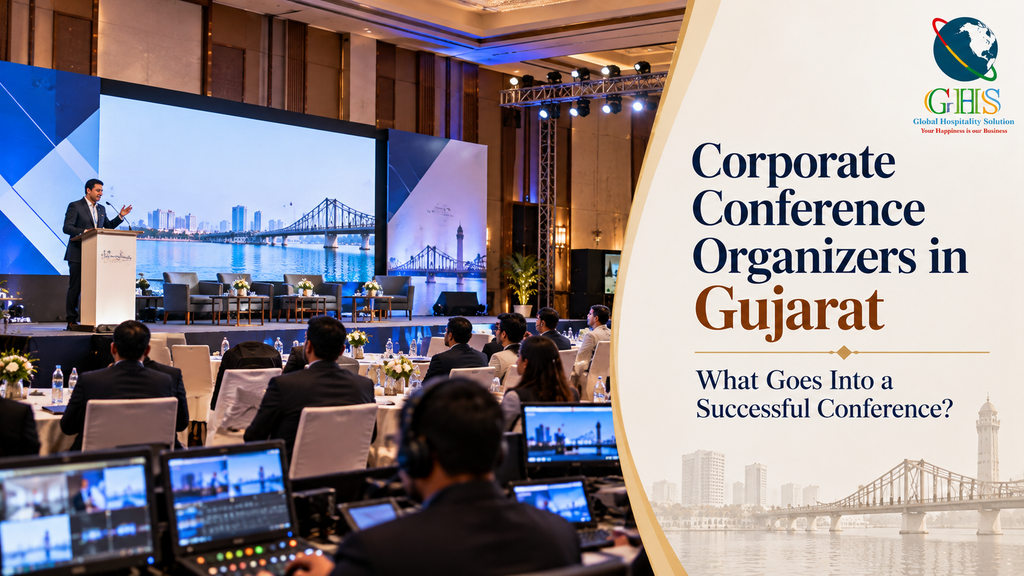
Corporate conferences provide a structured environment for businesses to exchange knowledge, communicate strategies, introduce new developments and strengthen professional relationships. From annual business meetings and leadership conferences to industry seminars, dealer meets and product presentations, these events bring people together around specific organisational objectives. Their success depends not only on the quality of the speakers or venue but also on how effectively the entire programme is planned and coordinated.
Gujarat offers a relevant environment for corporate conferences because of its industrial base, business centres and developing event infrastructure. Ahmedabad, Gandhinagar, Vadodara and Surat serve different corporate and industrial audiences, while larger convention facilities can accommodate conferences, exhibitions and business gatherings.
The scale of India’s broader MICE industry reinforces the importance of professional planning. A May 2025 release from the Press Information Bureau, citing market estimates, valued India’s Meetings, Incentives, Conferences and Exhibitions (MICE) market at approximately US$49.4 billion in 2024, with projections of around US$103.7 billion by 2030. These figures cover the wider MICE market rather than corporate conferences alone, but they indicate the commercial significance of organised business events.
A successful corporate conference therefore requires coordination across strategy, venue selection, agenda design, technology, accommodation, transportation, hospitality and post-event evaluation. Each element must support the purpose of the gathering and the needs of its delegates.
Understanding the Purpose of a Corporate Conference
The first stage of conference planning is to establish what the organisation expects to achieve. Without a clearly defined objective, decisions about the venue, agenda, speakers, production and budget can become disconnected.
A leadership conference may focus on business performance, strategic priorities and internal alignment. A dealer conference may concentrate on product knowledge, sales performance and partner relationships. An industry conference, meanwhile, may require expert presentations, panel discussions, technical sessions and opportunities for professional networking.
The intended audience also influences the format. Senior executives may require a focused programme with private discussion areas, while a large employee conference may need multiple presentation sessions, registration desks, catering arrangements and extensive audiovisual support.
Objectives should be translated into measurable outcomes wherever possible. These might include delegate attendance, session participation, stakeholder engagement, feedback scores, completed business meetings or follow-up actions. Establishing these indicators early provides a basis for evaluating the event after it concludes.
Selecting the Right Conference Venue in Gujarat
Venue selection affects almost every aspect of a conference, including accessibility, attendee comfort, technical requirements, catering and programme scheduling. A venue should therefore be evaluated according to the event’s operational needs rather than its appearance alone.
Ahmedabad may be suitable for conferences involving corporate headquarters, professional services and regional business networks. Gandhinagar offers access to convention infrastructure and institutional facilities, while Vadodara and Surat can be practical choices for industry-specific gatherings depending on the audience and location of participating businesses.
The scale of available infrastructure varies considerably. For example, the official website of the Helipad Exhibition Centre in Gandhinagar reports more than 100,000 square metres of exhibition area across 13 halls. Although exhibition space should not be confused with dedicated conference seating, the facility illustrates the scale of event infrastructure available in Gujarat.
The venue assessment should cover usable seating capacity, stage dimensions, ceiling height, room configuration, power supply, internet connectivity, accessibility, parking, loading access and emergency arrangements. Breakout rooms may be necessary for parallel sessions, workshops or private meetings.
GHS’s venue selection and banquet planning services are relevant when conference space, hospitality facilities and supporting arrangements need to be considered together.
Matching the Venue to the Conference Format
A theatre-style layout can accommodate a large audience for presentations, whereas classroom seating is more suitable when delegates need to take notes or use laptops. A boardroom layout encourages discussion among smaller groups, while round-table arrangements support workshops and collaborative sessions.
The selected layout should also account for sightlines, microphone access, screen visibility and movement between seating areas. A room that technically accommodates the expected number of delegates may still be unsuitable if the stage, aisles and technical equipment reduce usable space.
Developing a Structured Conference Agenda
An effective conference agenda balances information delivery with opportunities for interaction. Too many presentations can cause fatigue, while long gaps between sessions can disrupt engagement and create operational complications.
The agenda should establish a logical progression from opening remarks and context-setting presentations to technical discussions, panel sessions, networking and closing observations. Each session should have a defined purpose, appropriate duration and clear connection to the overall conference objective.
Breaks are operationally important rather than merely optional. They provide time for refreshments, informal discussions, movement between rooms and technical adjustments. Their timing should reflect the programme’s intensity and the number of attendees.
For conferences with multiple tracks, parallel sessions require careful scheduling. Organisers need to prevent unnecessary conflicts between sessions aimed at the same audience and ensure that delegates can move between rooms without missing important content.
Speaker coordination is another essential responsibility. Presentation formats, session timings, technical requirements, biographies and presentation files should be collected before the event. A detailed run sheet helps the production team, speakers, moderators and stage manager work from the same schedule.
Managing Conference Production and Audiovisual Requirements
Audiovisual production is central to conferences that depend on presentations, keynote addresses, panel discussions, product demonstrations or live streaming. Poor sound quality, unreadable screens or delayed presentations can interrupt the programme even when every other arrangement is in place.
The production plan should be prepared alongside the venue layout. Screen size and position must suit the room, microphones should match the session format, and lighting should support both visibility and presentation requirements. Large stages may require confidence monitors, presentation computers, stage lighting and dedicated technical operators.
Internet connectivity should be tested according to the actual use case. A conference relying on live streaming, remote speakers, digital presentations or audience interaction has different bandwidth and reliability requirements from an event using only offline presentations.
Technical rehearsals allow organisers to check presentation files, microphone levels, lighting cues, video playback and transitions before delegates arrive. Backup equipment and clearly assigned technical responsibilities can reduce the effect of unexpected failures.
Professional corporate event production and AV services can support the integration of stage, sound, lighting, visual displays and other technical elements into the conference programme.
Registration and Delegate Management
Registration is one of the first points of contact between the conference and its attendees. A poorly organised registration process can create queues, delay opening sessions and affect the initial impression of the event.
Pre-registration allows organisers to estimate attendance, prepare badges and identify special requirements before the conference begins. Digital registration and QR-based check-in can accelerate entry when supported by reliable systems and a suitable on-site process for attendees who need assistance.
Delegate records should contain only the information required for event administration and communication. Access to these records should be controlled, and attendee information should be handled responsibly.
The registration area also needs sufficient space for queues, badge collection and assistance. For larger conferences, separate counters may be appropriate for speakers, invited guests, general delegates and on-site registrations.
Clear signage, session schedules and directional information help attendees move between the registration area, conference hall, breakout rooms and catering spaces without repeatedly seeking assistance.
Coordinating Accommodation, Transport and Hospitality
Conferences involving delegates from multiple cities require coordination beyond the meeting venue. Hotel reservations, airport or railway transfers, meal schedules and local transportation must align with the programme.
Accommodation planning should account for arrival and departure dates, room categories, occupancy, check-in times and special requirements. Room blocks should be based on realistic attendance estimates, with clear deadlines for confirming or releasing unneeded inventory.
Transport schedules should include reasonable buffers for traffic, group movement and delays. Speakers and senior delegates may require different transfer arrangements from general attendees, depending on the conference format.
Hospitality also includes food and beverage planning. Menus should reflect the duration of the event, delegate preferences, dietary requirements and the timing of sessions. Refreshment breaks must be long enough to serve the expected number of people without causing late returns to the conference hall.
For conferences involving residential arrangements, national and international hotel accommodation services can be considered alongside the venue and transportation plan.
Conference Budgeting and Supplier Coordination
A conference budget should reflect the complete delivery cost rather than the venue rental alone. Major cost areas commonly include venue hire, catering, audiovisual production, stage and branding, accommodation, transport, speaker requirements, registration systems, staffing and contingency provisions.
Separating fixed costs from variable costs improves financial planning. Venue rental and certain production charges may remain stable, while catering, delegate materials and accommodation generally change with attendance. The budget should also distinguish essential requirements from optional enhancements.
Supplier coordination is equally important. Venue teams, caterers, production technicians, decorators, transport providers and registration staff must work according to one operational schedule. Late changes to the stage layout, for example, can affect lighting, screen placement, cable routing and seating arrangements.
A central coordination document should identify responsibilities, deadlines, dependencies and escalation contacts. This reduces ambiguity and makes it easier to respond to changes without disrupting the wider programme.
Measuring Conference Success After the Event
The conclusion of the final session does not mark the end of conference management. Post-event evaluation helps determine whether the gathering achieved its objectives and identifies improvements for future programmes.
Attendance figures provide a basic measure, but they do not explain the quality of participation. Organisers should also review session attendance, speaker feedback, delegate satisfaction, networking participation, completed meetings and the extent to which the event generated useful follow-up activity.
Feedback surveys are most useful when questions are specific and actionable. Delegates can be asked to assess session relevance, venue suitability, technical quality, registration, catering and the overall programme structure. Short surveys distributed soon after the event may help capture impressions while the experience remains fresh.
Financial evaluation should compare actual spending with the approved budget and document the reasons for significant variances. Supplier performance, schedule adherence and operational issues should also be recorded.
For conferences intended to support business development or internal strategy, the evaluation period may extend beyond the event itself. Follow-up meetings, sales opportunities, project decisions and completed action items can provide a more meaningful indication of long-term value.
Conclusion
A successful corporate conference is the result of coordinated planning rather than a single impressive venue or well-known speaker. Clear objectives, an appropriate location, a structured agenda, reliable AV production, efficient registration, comfortable hospitality and disciplined supplier management all contribute to the quality of the event.
Gujarat offers a range of business centres and event facilities for conferences of different sizes and purposes. Selecting the right location requires an understanding of the audience, the programme format, technical requirements and the resources available at the venue.
Professional conference organisers bring these components together through detailed planning, operational coordination and post-event evaluation. When each decision supports the conference objective, the event becomes a productive platform for communication, learning, collaboration and stronger business relationships.
Frequently Asked Questions
What do corporate conference organisers in Gujarat manage?
Corporate conference organisers coordinate planning activities such as venue selection, agenda development, speaker management, registration, audiovisual production, hospitality, transportation, supplier coordination and post-event evaluation.
Which cities in Gujarat are suitable for corporate conferences?
Ahmedabad, Gandhinagar, Vadodara and Surat are potential locations. The most appropriate city depends on delegate origins, industry requirements, venue capacity, travel connections and the type of conference being organised.
How early should a corporate conference be planned?
The planning period depends on the event’s scale and complexity. Larger conferences with multiple speakers, residential accommodation, elaborate production or international delegates generally require more preparation than smaller business meetings. Venue availability and supplier lead times should guide the schedule.
What is the role of audiovisual production in a conference?
Audiovisual production supports clear communication through sound systems, microphones, screens, lighting, presentation equipment and, where required, streaming technology. Technical rehearsals and backup arrangements help reduce disruptions.
How can organisers measure the success of a corporate conference?
Success can be evaluated through attendance, session participation, delegate feedback, speaker satisfaction, budget performance, completed meetings and follow-up outcomes linked to the original conference objectives.