

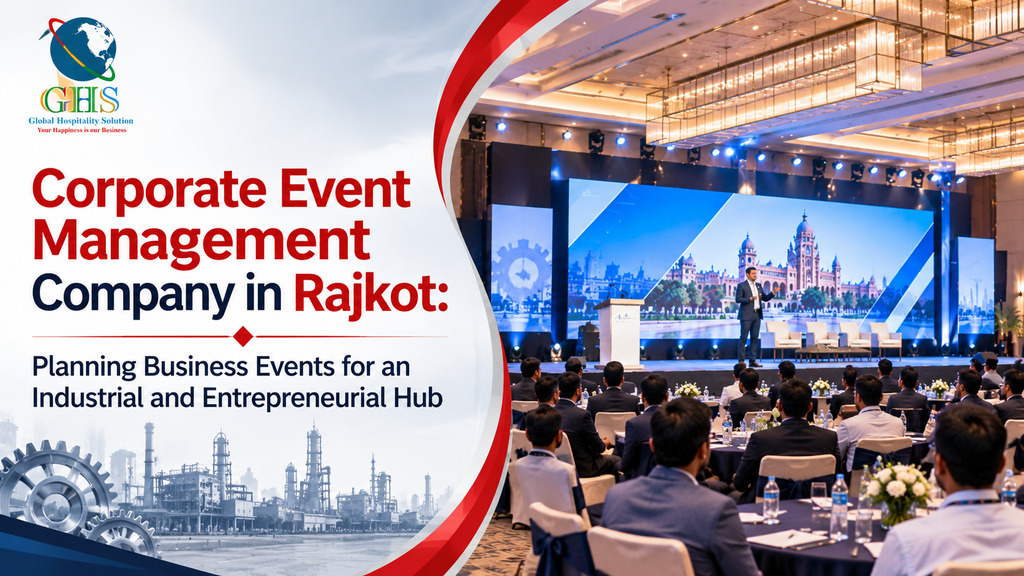
Introduction
Rajkot has developed into one of Gujarat’s important centres for manufacturing, engineering, trade and entrepreneurship. Its industrial landscape includes engineering components, automotive parts, bearings, foundries, machine tools, jewellery, food processing and several other business segments. The city also serves as an important commercial centre for the wider Saurashtra region, connecting manufacturers, suppliers, distributors, business owners and professional networks.
As businesses expand their operations and establish wider market connections, corporate events have become an important part of business communication. Industry conferences, dealer meets, product launches, annual gatherings, business exhibitions, training programmes and corporate celebrations provide structured opportunities to exchange knowledge, introduce developments and strengthen professional relationships.
However, organising a successful business event requires more than arranging a venue and inviting guests. It involves coordinating multiple elements, including event objectives, venue suitability, technical production, hospitality, scheduling, guest management and on-ground execution. These requirements make professional event planning particularly relevant for companies operating in an active commercial environment such as Rajkot.
A corporate event management company in Rajkot helps businesses bring these requirements together through structured planning and coordinated execution. The effectiveness of an event depends on how well its business purpose, audience expectations and operational arrangements are aligned.
Rajkot’s Business Environment and the Growing Importance of Corporate Events
Rajkot’s industrial identity creates several opportunities for business gatherings and professional events. The city is recognised for its engineering and manufacturing ecosystem, with industrial activity spread across areas such as Aji, Metoda and Shapar. Its manufacturing base includes automotive components, casting and forging, bearings, pumps, machine tools and industrial equipment.
The Government of India’s district export profile also identifies engineering goods and automotive-related manufacturing among Rajkot’s important industrial activities. These sectors depend on networks of manufacturers, component suppliers, distributors, technology providers and buyers, making professional business interactions an important part of commercial development.
Corporate events provide a structured environment for these interactions. A manufacturer may organise a dealer conference to communicate annual targets, while an engineering company may arrange a technical seminar to introduce new production capabilities. A business association may host an industry meeting, whereas a growing enterprise may conduct an annual gathering to recognise employees and communicate organisational priorities.
The purpose and audience differ across these formats, but the underlying requirement remains similar: the event must create an organised environment where information, business relationships and professional experiences come together.
Corporate Events That Support Rajkot’s Business Community
Industry Conferences and Business Meetings
Industry conferences bring together professionals, manufacturers, suppliers, consultants and business representatives to discuss sector-specific developments. In a manufacturing-oriented city such as Rajkot, these gatherings may focus on engineering advancements, production processes, supply-chain requirements, industrial technology or emerging business opportunities.
The planning requirements depend on the event’s format and expected participation. A technical conference may need presentation facilities, panel discussion arrangements, registration management and suitable seating. A smaller business meeting may require a private conference room, audiovisual equipment and hospitality arrangements.
The agenda must also allow sufficient time for presentations, discussions, networking and scheduled breaks. A carefully structured programme helps maintain participation while ensuring that the event achieves its intended business purpose.
Dealer Meets and Channel Partner Conferences
Dealer and distributor networks are important to businesses operating across manufacturing, automotive components, machinery and consumer products. Companies frequently organise dealer meets to introduce new products, communicate sales strategies, discuss distribution requirements and strengthen relationships with channel partners.
These events require a balance between formal business communication and relationship-building activities. Product presentations, leadership addresses, recognition ceremonies, networking sessions and hospitality arrangements may all form part of the programme.
Venue selection is particularly important when participants are travelling from different cities. Accommodation, transport coordination, registration and meal schedules should be considered alongside the main conference arrangements.
Product Launches and Business Showcases
A product launch provides an opportunity to introduce a new offering to customers, distributors, industry professionals or business partners. For engineering and manufacturing companies, the launch may involve technical demonstrations, product displays, presentations and discussions about specifications or applications.
The event environment must support the product itself. Display space, lighting, screen visibility, presentation technology and visitor movement should be planned according to the product’s size and demonstration requirements.
A machinery showcase, for example, may need a different venue layout from a software product launch. Understanding these differences during the planning stage helps avoid operational limitations on the event day.
Annual Meetings, Corporate Celebrations and Employee Events
Corporate events also serve internal organisational purposes. Annual meetings, employee recognition programmes, leadership gatherings, milestone celebrations and team events provide opportunities to communicate achievements and strengthen workplace relationships.
These occasions often involve a combination of formal presentations, award ceremonies, entertainment, dining and group activities. Their success depends on maintaining a suitable balance between the organisation’s message and the experience of its employees.
What Goes into Professional Corporate Event Planning?
Establishing the Event Objective and Requirements
Every event should begin with a clearly defined purpose. The objective determines the format, audience, venue, programme and resources required for execution.
A dealer conference focused on product education may need technical presentations and demonstration areas. A leadership meeting may require a private setting, structured discussions and presentation facilities. An annual celebration may place greater emphasis on stage design, entertainment, dining and guest experience.
The planning brief should identify the expected number of attendees, event duration, preferred location, programme structure, budget range and essential technical requirements. Establishing these details early makes it easier to evaluate suppliers, shortlist venues and develop a realistic execution plan.
Selecting a Venue That Matches the Event Format
Venue selection has a direct influence on the event’s functionality. A visually attractive property may not necessarily be suitable for every business gathering. Seating capacity, stage dimensions, ceiling height, accessibility, parking, catering arrangements, technical infrastructure and guest movement all require consideration.
A conference involving presentations and panel discussions may require a dedicated meeting hall with appropriate acoustics and screen visibility. A dealer meet with product displays may need additional exhibition space, while a corporate celebration may require a banquet venue with suitable dining and stage arrangements.
Location also matters. Venues should be evaluated according to participant travel requirements, proximity to accommodation, road connectivity and the availability of local transport.
A structured venue selection and banquet planning process helps businesses assess these practical requirements before confirming a property.
Managing Event Production and Technical Requirements
Audiovisual production is an important component of modern corporate events. Sound systems, microphones, LED displays, projectors, stage lighting and presentation equipment support communication between speakers and audiences.
Technical requirements should be established according to the programme rather than selected independently of it. A product launch may require high-quality visual displays and demonstration equipment, while a multi-speaker conference may need multiple microphones, presentation switching and appropriate stage lighting.
The technical team should also consider power availability, equipment placement, cable management, backup arrangements and rehearsal schedules. A sound check and presentation test before guest arrival can identify potential issues while there is still time to address them.
Professional coordination of event production and audiovisual solutions helps ensure that technical elements support the programme instead of becoming an operational distraction.
Coordinating Hospitality and Guest Arrangements
Hospitality planning becomes more complex when participants travel from outside Rajkot. Accommodation, airport or railway transfers, local transportation, meals, registration and guest assistance must be coordinated with the event schedule.
For multi-day conferences, room allocation and check-in arrangements should be planned in advance. The organisers must also account for arrival patterns, dietary requirements, special assistance and movement between the hotel and event venue.
Accommodation should be selected according to location, guest profile, budget and available facilities. A well-organised hotel accommodation arrangement helps maintain consistency between the event programme and the overall guest experience.
Why Event Coordination Matters More Than Individual Arrangements
Corporate events involve several service providers working within the same timeline. Venue teams, caterers, audiovisual technicians, decorators, transport operators, hospitality staff and event coordinators must follow a shared programme.
When these activities are managed independently, communication gaps can affect the event schedule. A delayed stage setup may interfere with technical rehearsals, while a change in guest arrival timings can affect registration and catering arrangements.
Centralised coordination helps connect these operational activities. A master event schedule should identify important milestones, responsible teams, setup timings, rehearsal periods and programme transitions. Regular communication between departments allows adjustments to be managed without disrupting the overall event.
Contingency planning is equally important. Technical failures, delayed deliveries, changes in attendance and unexpected venue restrictions should be considered before the event begins. Alternative arrangements for critical equipment, communication channels and essential services can reduce operational uncertainty.
The objective is not to eliminate every possible disruption but to ensure that the organising team can respond quickly and maintain the event’s essential programme.
How Businesses Can Evaluate a Corporate Event Management Company in Rajkot
Selecting an event management partner requires an assessment of planning capability, operational coordination and the ability to understand business requirements. The decision should not be based only on visual presentation or the quoted service price.
Understanding of Business Event Formats
An event partner should understand the differences between conferences, dealer meets, product launches, exhibitions, employee gatherings and formal corporate celebrations. Each format has distinct requirements relating to audience management, technical arrangements, programme design and hospitality.
The planning approach should reflect the organisation’s objectives rather than applying the same format to every event.
Venue and Supplier Coordination
A capable planning team should be able to assess venue suitability and coordinate the services required for execution. This includes communication with hotel teams, production vendors, decorators, caterers and transportation providers.
Clear responsibility allocation helps reduce confusion, particularly when several suppliers are involved.
Budget Planning and Cost Transparency
A corporate event budget should account for the complete scope of work. Venue charges, catering, accommodation, production, décor, transportation, staffing and other operational expenses should be considered during the initial planning stage.
Businesses should also understand which services are included in a proposal and which may attract additional costs. Transparent budgeting supports better financial decisions and reduces the likelihood of unexpected expenditure.
On-Ground Management and Execution
Planning documents and supplier confirmations are only part of event management. On-ground execution requires a team that can supervise setup, monitor schedules, coordinate participants and respond to changing requirements.
The event management partner should establish communication responsibilities and escalation procedures before the event day. This becomes particularly important for conferences and multi-session programmes where timing affects several activities.
Measuring the Success of a Corporate Event
The success of an event should be evaluated against its original objectives rather than attendance alone. A well-attended gathering may still fall short if the intended business outcomes are not achieved.
For a dealer conference, useful indicators may include partner participation, product enquiries, feedback and follow-up meetings. A training event may be assessed through attendance, session completion and participant evaluations. An employee gathering may focus on participation, internal feedback and engagement.
Operational performance should also be reviewed. Budget adherence, schedule management, registration efficiency, hospitality feedback and technical reliability provide useful information about the quality of execution.
A post-event review helps organisations identify improvements for future programmes. Feedback from participants, internal teams and service providers can reveal practical issues that may not be visible during the event itself.
The Role of an Integrated Event Management Approach
A corporate event is a combination of interconnected decisions. Venue selection affects technical planning, the guest list influences accommodation requirements, and the programme determines staffing and production schedules. Treating these elements as separate activities can create gaps between planning and execution.
An integrated approach brings the major requirements under a coordinated framework. It connects the event brief with venue evaluation, budgeting, production planning, hospitality, supplier management and on-site supervision.
For organisations hosting conferences, business gatherings and corporate programmes in Rajkot, this approach provides a clearer structure for managing responsibilities and maintaining consistency throughout the event lifecycle.
Global Hospitality Solutions works across corporate event planning, venue coordination, hospitality and production-related requirements, reflecting the importance of connecting these elements within a single event plan.
Conclusion
Rajkot’s manufacturing, engineering and entrepreneurial ecosystem creates a strong setting for professional business interactions. As companies strengthen supplier networks, develop distribution channels, introduce products and organise industry gatherings, corporate events continue to serve important communication and relationship-building purposes.
A successful event depends on more than selecting an attractive venue or arranging individual services. It requires a clear objective, a suitable location, realistic budgeting, coordinated technical production, organised hospitality and effective on-ground management.
Choosing a corporate event management company in Rajkot should therefore involve evaluating its ability to understand the business purpose and coordinate the operational details required to achieve it. A structured planning approach helps organisations create events that are professionally managed, relevant to their audiences and aligned with their wider business objectives.
Frequently Asked Questions
1. What services does a corporate event management company in Rajkot provide?
Corporate event management services may include event planning, venue selection, stage and audiovisual production, catering coordination, accommodation, transportation, guest management, décor, programme scheduling and on-site supervision. The exact scope depends on the event format and organisational requirements.
2. What types of corporate events can be organised in Rajkot?
Businesses can organise industry conferences, dealer meets, product launches, annual meetings, exhibitions, training programmes, leadership gatherings, employee celebrations and networking events. Each format requires a different combination of venue, production and hospitality arrangements.
3. How should a company select a venue for a corporate event in Rajkot?
Venue selection should consider guest capacity, location, accessibility, parking, seating arrangements, stage requirements, audiovisual infrastructure, catering facilities and accommodation availability. The venue should match the event format and participant profile.
4. When should corporate event planning begin?
The planning timeline depends on the event’s scale, format, guest count and venue requirements. Larger conferences and multi-day programmes generally require more preparation than smaller meetings. Starting early provides greater flexibility for venue selection, supplier coordination, budgeting and guest arrangements.
5. What factors influence the budget of a corporate event?
Major cost components include venue rental, food and beverages, audiovisual production, stage setup, décor, accommodation, transportation, staffing and entertainment. Guest count, event duration, property category and technical complexity also influence the overall budget.
6. Why is professional event coordination important?
Professional coordination connects different service providers, maintains the event schedule and establishes clear responsibilities. It also helps manage operational changes, technical requirements and guest arrangements, reducing the likelihood of communication gaps during execution.
7. Can a corporate event management company coordinate accommodation and transportation?
Depending on its service scope, an event management company can coordinate hotel bookings, guest room allocation, arrival schedules and local transportation. These arrangements are particularly useful for conferences and business gatherings involving participants travelling from multiple locations.